
MOVING GUIDE
What Size U-Haul Truck Do I Need? Penske and Budget Too
Short answer
U-Haul points a studio or one-bedroom to a 10- or 15-foot truck, two bedrooms to a 15- or 20-foot, and three or four bedrooms to a 26-foot. Here are the official sizes and room guides from U-Haul, Penske and Budget, and what really fills a truck.
For a very large home, U-Haul points to its 29-foot. Penske and Budget sort their trucks a little differently. U-Haul and Penske say their measurements are approximate, and Budget says capacity varies with the size of your rooms and what is in them. So treat the bedroom count as a starting point and look at your biggest pieces of furniture.
This guide lines up what each company says, gives the inside measurements, and explains what a crew looks at when it loads a truck. We do the loading and unloading, not the renting. We are not affiliated with U-Haul, Penske or Budget.
What each company says fits which home
These are the sizes each company points to, from U-Haul, Penske and Budget's truck pages (12-foot, 16-foot, 26-foot).
| Home | U-Haul | Penske | Budget |
|---|---|---|---|
| Studio | 10 ft | Cargo van or 12 ft | 12 ft |
| 1 bedroom | 10 or 15 ft | 16 ft | 16 ft |
| 2 bedrooms | 15 or 20 ft | 22 ft | 26 ft |
| 3 bedrooms | 20 or 26 ft | 22 or 26 ft | 26 ft |
| 4 bedrooms or more | 26 or 29 ft | 26 ft (its largest) | 26 ft (its largest) |
In the companies' own words: U-Haul lists its 10-foot for a studio to 1 bedroom, its 15-foot for 1 to 2 bedrooms, its 20-foot for 2 to 3, its 26-foot for 3 to 4 and its 29-foot for 4 to 6. Penske lists its cargo van for up to 1 room, its 12-foot for 1 to 2 rooms, its 16-foot as the right size for a one-bedroom apartment, its 22-foot for one to three bedrooms, and its 26-foot, its largest for a personal move, for three to five. Budget lists its 12-foot for 1 to 2 rooms or a studio, its 16-foot for a 1 bedroom home, and its 26-foot, the largest it lists, for a 2 to 3 bedroom home.
The companies do not agree exactly. Budget lists its 26-foot for a 2-3 bedroom home, while U-Haul's 26-foot is for three to four. Budget's own 16-foot page also says to rent a 26-foot if your space is more than 1,200 square feet. When two guides disagree, the larger truck is the safer reading.
The inside sizes
Length, width and height are inside the cargo box. Per-truck U-Haul pages differ slightly from its comparison chart, so we used the individual truck pages. All figures were checked on each company's site on October 6, 2026; confirm with the rental company when you book.
U-Haul (10-foot, 15-foot, 20-foot, 26-foot, 29-foot)
| Truck | Inside (L x W x H) | Cubic feet | Max load | Deck height | Ramp |
|---|---|---|---|---|---|
| 10-foot | 9'11" x 6'3" x 6'1" | 402 | 2,850 lbs | 29" | None |
| 15-foot | 15' x 7'8" x 7'2" | 764 | 6,385 lbs | 33" | Yes |
| 20-foot | 19'5" x 7'8" x 7'1" | 1,016 | 5,700 lbs | 35" | Yes |
| 26-foot | 26'2" x 8'1" x 8'3" | 1,682 | 12,859 lbs | 35" | Yes |
| 29-foot | 29'2" x 8'1" x 8'9" | 2,057 | 11,939 lbs | 30 to 34" | Yes |
Penske ("up to" sizes from its 12-foot, 16-foot, 22-foot and 26-foot pages)
| Truck | Inside (L x W x H) | Cubic feet | Max load |
|---|---|---|---|
| 12-foot | up to 12' x 6'6" x 6'1" | up to 450 | up to 3,100 lbs |
| 16-foot | up to 16' x 7'7" x 6'6" | up to 800 | up to 4,300 lbs |
| 22-foot | up to 21'11" x 8'1" x 8'1" | up to 1,200 | up to 10,000 lbs |
| 26-foot | up to 25'11" x 8'1" x 8'1" | up to 1,700 | up to 10,000 lbs |
Budget: the 12-foot is about 10' x 6'3" x 6' inside, or 380 cubic feet. The 16-foot is about 16' x 6'3" x 6'7", or 658 cubic feet. The 26-foot is about 26' x 8'1" x 8'1", or 1,698 cubic feet.
Notice that the name is not the inside length. A Budget "12-foot" is about 10 feet inside, while Penske lists its 12-foot as up to 12. And U-Haul's 20-foot has a lower maximum load than its 15-foot. Check the weight limit if you own a lot of books, tools or heavy appliances.
Bulky furniture matters more than the room count
Bedrooms are a rough guess. What fills a truck is the large, awkward stuff, because boxes stack and furniture does not.
U-Haul's own 15-foot loading guide lists the pieces to plan around: a king mattress, a three-seat sofa, a washer and dryer, a refrigerator, dressers and dozens of boxes. These are the items to count.
- Sofas and sectionals. A sectional takes the floor space of several pieces. Count each piece.
- Mattresses. They stand on their sides against a wall, and a king takes more of the width than a twin.
- Washer, dryer and fridge. These are heavy and go in first, so they eat floor space at the front.
- Dining tables, bookshelves and desks. Ask whether the legs come off.
- Boxes. They fill the gaps and the top, so count them last.
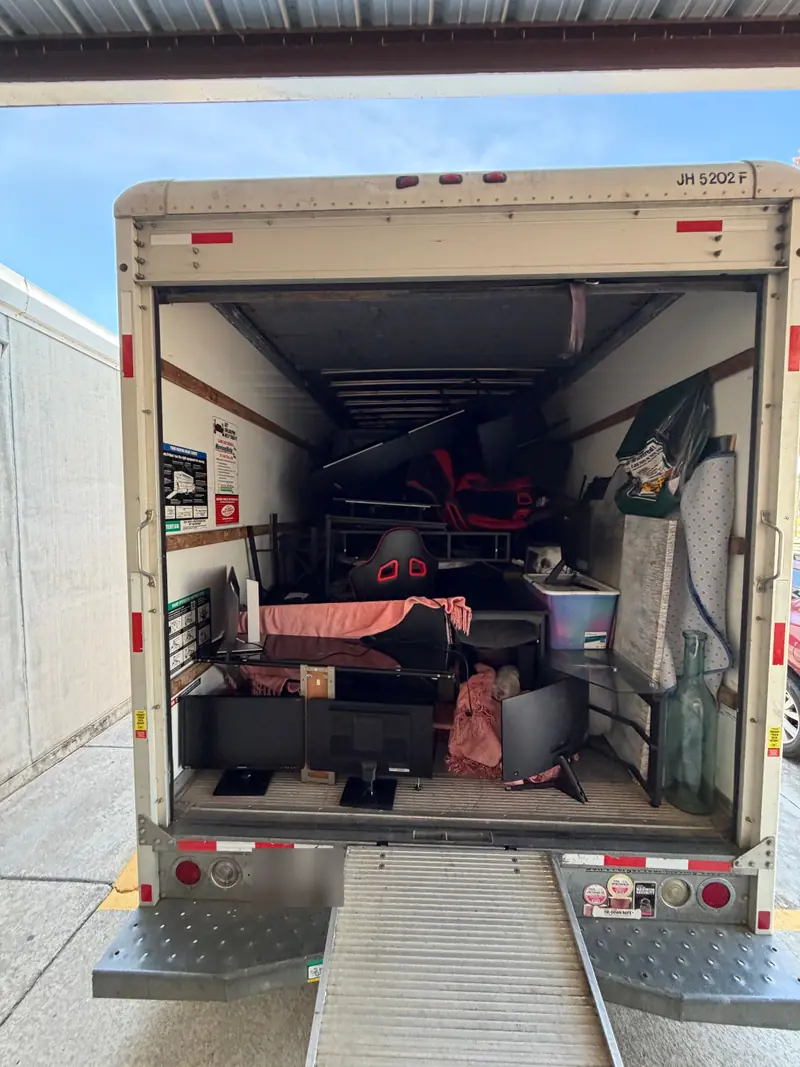
When two sizes could work, a little spare room makes loading easier. A truck that is too small means a second trip or leaving things behind.
What changes by truck size
- Ramp. U-Haul says its 10-foot truck has no loading ramp, so everything is lifted up to a deck about 29 inches high. Its larger trucks do have ramps. Penske lists a 1,000-pound ramp on its 16-, 22- and 26-foot trucks. Budget says ramps and lift-gates are available on its 26-foot, so check what you are getting when you reserve.
- Deck height. The deck is the floor of the truck. A higher deck means a bigger lift or a steeper ramp when you push a heavy dolly.
- Mom's Attic. U-Haul's 15-, 20-, 26- and 29-foot trucks have a space over the cab that U-Haul designed for fragile items kept apart from heavy furniture. Lamps, frames and keepsakes ride well there.
- Driving. A bigger truck is taller and longer. U-Haul lists clearance of 9 feet on its 10-foot, 11 feet on its 15- and 20-foot, and 12 feet on its 26-foot. Check driveways, trees and parking decks.
You can also rent dollies and furniture pads. U-Haul says they are available at its locations and can be added to an online reservation. Tell us what you already have so we know what to bring.
What a crew checks before you reserve
If you put your biggest pieces in your quote request, Joey can talk the truck size through with you when he texts you back. This is what we look at:
- The three or four biggest pieces. A sofa, a mattress, a fridge and a dresser tell us most of what we need.
- Appliances and anything long, like a sofa or a tall bookcase. Long pieces set the minimum inside length.
- Stairs and the walk to the truck. A long carry and many stairs add time but do not change the truck size.
- Where the truck will park. It needs space for the ramp and for people to walk around it.
Loading goes in tiers from front to back, with heavy items low and against the cab wall, and each tier strapped before the next. Our guide on how to load a moving truck walks through that order.
When two loads make sense
If you are between a truck and a container, or your home is bigger than one truck, a container can carry the overflow. PODS says its 8-, 12- and 16-foot containers are about the size of a 10-, 15- and 20-foot truck. Our guide to moving without a truck of your own compares the options.
Tell us the truck size
When you request loading or unloading help, tell us the truck size and the reservation time. Add your biggest pieces and any stairs in the notes. Joey texts you back, and he can tell you what he sees in your list. The same goes for crew size: our guide to how many movers you need can help you decide.