
MOVING GUIDE
Where to Park a Moving Truck in Raleigh and Nearby
Short answer
Park the truck as close to your front door as you legally can, on a flat spot with room to drop the ramp. A driveway is the easiest choice. On a Raleigh street, a reserved space goes through Raleigh Parking, so check the city's page before you count on the curb.
The parking spot is one of the few things on moving day you can settle weeks ahead. It decides how far every box and dresser has to travel, and that distance is repeated on every trip.
This guide is for houses, townhomes and duplexes in and around Raleigh. If you live in an apartment complex, the leasing office sets most of the rules, and our guide to apartment moves with elevators and parking in Raleigh covers that side.
How much room a moving truck needs
Start with the size of the truck. U-Haul lists the inside of its 15-foot truck as 15 feet long with an 11-foot clearance height, and its 26-foot truck as about 26 feet inside with a 12-foot clearance height. The cab adds length on top of that. U-Haul says all its truck measurements are approximate and the truck you get may vary, so measure against the numbers on your rental, not a guess.
Behind the truck you also need open ground for the ramp and a few feet past its end for the person rolling a dolly off it. Picture the truck, the ramp and a clear walking lane from the ramp to your door. That whole shape is the space you are looking for.
Look up as well as down. U-Haul's driving tips say the clearance is noted on the corner of the cargo box and warn that clearance levels are often not posted. Low tree limbs over a driveway, a carport roof or wires near the curb can all be in the way of a tall box truck.
Driveway, curb or cul-de-sac
Each spot has a trade-off. Here is how we think about them.
| Spot | Good for | Watch for |
|---|---|---|
| Driveway | Shortest, flattest carry | Slope, low branches, cars to move |
| Curb in front | Wide streets, short walk | Mailboxes, hydrants, neighbors' cars |
| Cul-de-sac | Room to stop | Turning a long truck around |
| Down the block | Last resort | Every trip gets longer |
The driveway is the first choice when the truck fits. Move your own cars out the night before, so the truck can back straight up toward the garage or front walk. A steep driveway makes the ramp steeper too, so check how it feels to push a loaded hand truck up it before you decide.
The curb works when the street is wide enough for traffic to pass. Park so the ramp lands on the sidewalk side, not in the lane. Ask neighbors the day before if they can leave the space in front of your house open.
A cul-de-sac gives room to stop, but a long truck needs room to turn around. Plan where it will face before it arrives.
What Raleigh says about street spaces
If you want a curb space held for the truck on a city street, Raleigh has a process for it. The city's page on right-of-way occupancy says Right-of-Way Services works with Raleigh Parking to issue permits for legal parking spaces used for things like dumpsters and portable storage devices. The same page says parking passes for moving vans and other vehicles can be obtained from Raleigh Parking directly, that the pass is picked up at the Parking office at 310 W. Martin Street, and that it must be displayed while the vehicle is in the space.
Read that page before your move and contact the city to ask what applies to your street, how far ahead to ask and what it costs. We do not know the current fees or lead times, so we will not guess at them here.
Outside Raleigh, each town sets its own rules. Some limit where large trucks may park on residential streets. If you live in a nearby town, check its own website or call town hall. Our Raleigh area page lists other local details worth knowing before a move.
HOAs, gates and townhome lots
A homeowners association can have its own rules about trucks, hours and where a moving vehicle may sit. Read your HOA's rules or call the management company before moving day. The same goes for gated communities: make sure the gate code works for a truck, and that the gate is wide and tall enough for one.
Townhome rows can be tight. Shared parking lots may have assigned spaces that belong to neighbors. Ask which spaces are open for loading, and for how long, before the truck shows up.
How the carry changes the day
This is the part a crew sees from the inside. The parking spot decides the walk, and the walk is the job.
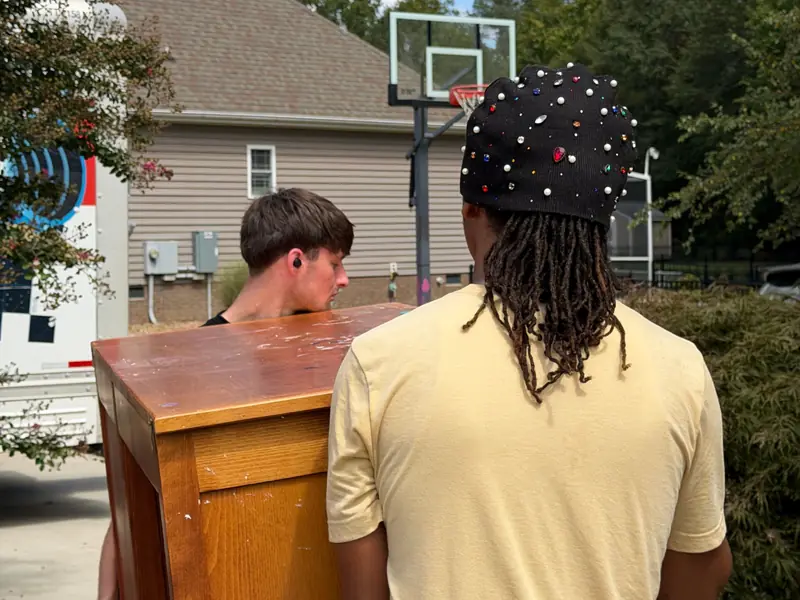
- Distance. A truck at the end of the driveway and a truck two houses down are different jobs. Each extra step is taken again on every trip.
- Surface. Gravel, grass and wet clay are slow for a dolly. A paved path or a sidewalk keeps things rolling.
- Steps and slopes. A few porch steps between the door and the truck mean heavy pieces get carried, not rolled.
- The ramp landing. If the ramp ends in a ditch, on a curb or on a slope, the crew loses time steadying every load.
- Blocked spots. If a car takes the space you planned, the truck ends up farther away, and the day stretches.
A longer carry can mean more hours, more movers, or both. Our guide on how many movers you need explains how we think about crew size when the walk is long.
Moving day: getting the truck into place
- Clear the spot the night before. Move your cars, trash cans and anything else out of the way.
- Have someone guide the driver. U-Haul's truck user instructions say to get help before you back up and not to rely on mirrors alone. One person outside, where the driver can see them, makes backing safer.
- Set the parking brake. U-Haul's driving tips say to set it once the truck is in place.
- Point the ramp at the door. Back in so the ramp lands as close as possible to the path the crew will use.
- Leave the walk clear. Hoses, toys, planters and doormats all trip a person carrying a box they cannot see past.
- Open the doors and prop them. Front door, storm door and garage door should stay open while the crew works.
If you are loading the truck yourself, our guide on how to load a moving truck walks through the order that keeps the load steady.
What to tell us about parking when you ask for a quote
You do not need a perfect answer, just an honest picture. When you send your request, tell us:
- Where the truck will sit: driveway, curb, cul-de-sac or somewhere else.
- About how far that is from the door, in steps or feet.
- Whether there are porch steps, a slope, gravel or grass on the way.
- Whether you have a city or HOA space reserved, or are still working on it.
- The truck size, if you have already rented one.
Joey will call you back and talk it through. One customer in Holly Springs put it this way:
★★★★★
“I would re-hire these guys in a heartbeat. They were incredibly fast, thoughtful, and detail oriented. …”
If the truck is booked and the parking plan is set, send us the details through our quote form and we will plan the crew around the walk.